


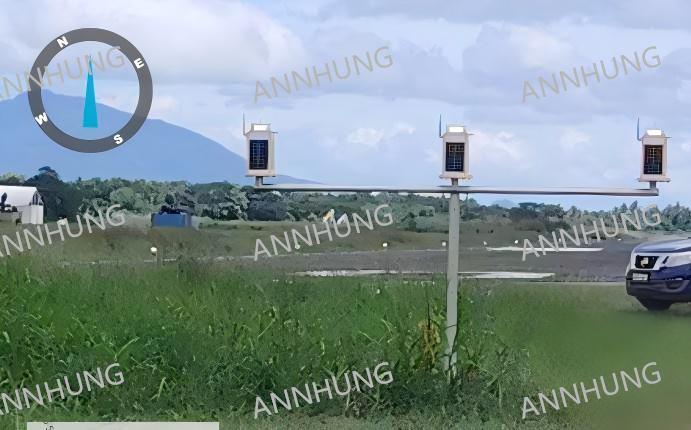
Philippines Military Airbase Runway Lighting Project: AH-SA-A Solar Airfield Runway Lights
Δημοσιεύτηκε στις: November 17, 2026
Project Overview
This case study covers a runway lighting installation delivered for a Philippine military airbase, using our AH-SA-A serial solar airfield runway lights. The airfield operates a compact runway with a parallel taxiway and a threshold/apron area, and it needed a complete, code-compliant lighting set that could be switched on for night operations without depending on the national grid or on diesel generators. Units were supplied in three configurations: white/white bidirectional runway edge lights, red/green bidirectional threshold and runway end lights, and blue omnidirectional taxiway edge lights.
Project Constraints
The site conditions ruled out a conventional wired airfield lighting system from the start:
- No reliable power along the runway — the strip sits far from the base's main distribution, and extending a medium-voltage feeder plus constant-current regulators was neither affordable nor quick to approve.
- No trenching permitted — cable trenches, ducts and pits would have cut through the runway shoulders and required heavy civil works on an active military airfield.
- Tropical marine climate — the Philippines exposes equipment to year-round humidity near 100%, torrential monsoon rain, salt-laden air and typhoon gusts. Standing water on the shoulders is normal after heavy rainfall.
- Operational resilience — the lighting had to keep working through power outages and be deployable or repositionable at short notice, including for temporary strips and emergency operations.
Selected Solution
The AH-SA-A is a fully self-contained solar airfield light: LED head, monocrystalline solar panels on four sides, lithium battery, charge controller and control electronics inside one IP68 die-cast aluminium housing. Nothing is wired between fixtures, so the whole airfield lighting layout was installed by positioning each unit on its mounting base — no trench, no cable, no regulator cabinet.
| Parameter | Specification supplied |
|---|---|
| Compliance | ICAO Annex 14 Vol. I (9th Edition, July 2022); ICAO Annex 14 Vol. II Heliports 5.3; FAA AC 150/5345-50B |
| Configurations used | AH-SA-A-RE-WW runway edge (white/white, bidirectional); AH-SA-A-TE-RG threshold / runway end (red/green); AH-SA-A-TE-B taxiway edge (blue, omnidirectional) |
| Light source | LED, >100,000 h rated life, 95% less power than equivalent incandescent |
| Peak intensity | White ≥610 cd, green ≥593 cd, yellow ≥294 cd, red ≥156 cd, blue ≥12 cd (higher intensity customized) |
| Solar module | Monocrystalline silicon, 5 W × 4 = 20 W total, microprocessor charge regulation |
| Battery | Lithium ion, ≥5 years service life (LiFePO4 optional) |
| Autonomy | 60 h high intensity bidirectional, 160 h medium, 300 h low |
| Control | ON/OFF button plus wireless handheld remote controller and monitor |
| Ingress protection | IP68, suitable for prolonged deep immersion |
| Environment | -55 to +70 °C, 0-100% RH, wind speed 80 m/s |
| Physical | Powder-coated die-cast aluminium body, UV-protected polycarbonate cover, 200 × 200 × M10 mounting, 250 × 250 × 370 mm, 6 kg |
Installation and Commissioning
Edge lights were set at standard longitudinal spacing along both runway sides, threshold and end lights at the strip extremities, and blue taxiway edge lights along the connecting taxiway. Each unit was fixed to the prepared base and levelled; final intensity and beam orientation were then confirmed by the airfield's electrical team on site.
Because there is no interconnect cabling, commissioning was a matter of addressing each fixture through the wireless remote controller: intensity mode, steady or flashing operation, and on/off state. The remote also serves as a diagnostic tool, letting base personnel monitor battery status and confirm that a fixture is charging correctly without climbing the shoulder or opening the housing.
The four-side solar panel layout was a decisive factor at this latitude. In a low-latitude, high-humidity site the sun path is close to overhead for much of the year, and the wrap-around panels average out partial shading coming from the light head itself, so charge input stays balanced across the day even with dust, dew and fast-moving monsoon cloud.
Results
- Full airfield lighting delivered with zero cable installation, zero civil works and zero additional power infrastructure.
- Autonomy of up to 300 hours at low intensity allows the system to ride through prolonged overcast and rain spells without intervention.
- IP68 sealing held through standing water on the shoulders after heavy monsoon rain, with no ingress observed at inspection.
- 80 m/s wind rating covers the installation against typhoon-grade gusts typical of the region.
- Remote control removed the need for a control tower link, giving the base an independent, fast-response lighting capability for night flights and emergency operations.
Conclusion
Where utility power is absent, unreliable or too expensive to extend, the AH-SA-A series converts a runway lighting requirement into a straightforward installation task: place, level, switch on. This Philippine military airbase project demonstrates the model in a demanding tropical environment, and the same approach applies directly to regional and remote airfields, helipads and heliports (FATO, TLOF, flight path alignment guidance), temporary or expeditionary strips, and emergency operating sites.

